AECB Credit Score in the UAE (2026): How to Check It, What It Costs and How to Improve It
A number between 300 and 900 decides your credit card and loan approvals in the UAE. How to check it in minutes, what really moves it, and why your Tabby and Tamara payments now count.
By the Finance Arabia editorial team4 min read
In the UAE, a three-digit number decides whether you get a credit card, how much a bank will lend you, and sometimes the interest rate you pay. It's your AECB credit score, issued by the federal credit bureau now branded Etihad Credit Bureau. Since July 2026 it also includes your Tabby and Tamara payments. This guide explains how the score works, how to check it in a few minutes, what it costs, and the habits that move it up or down.
What is the AECB score?
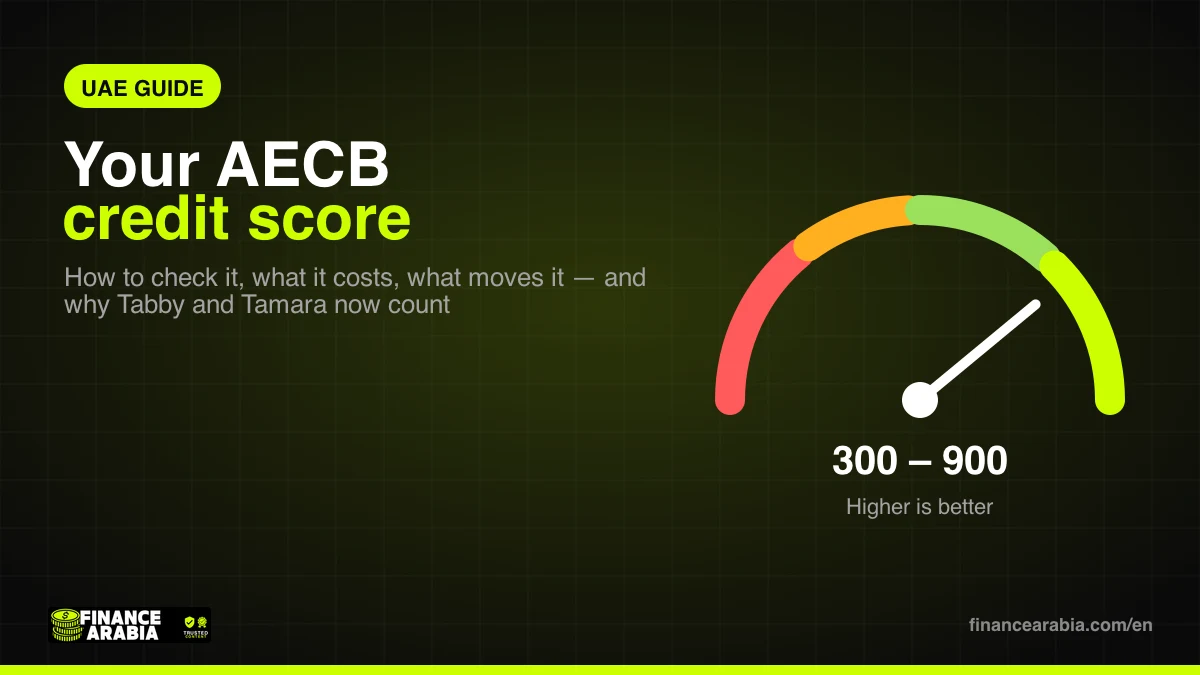
The Al Etihad Credit Bureau (AECB) collects data from banks, finance companies and other providers on your loans, credit cards, payment history and some other obligations. From that data it calculates a score between 300 and 900. A higher score tells lenders you're more likely to repay on time.
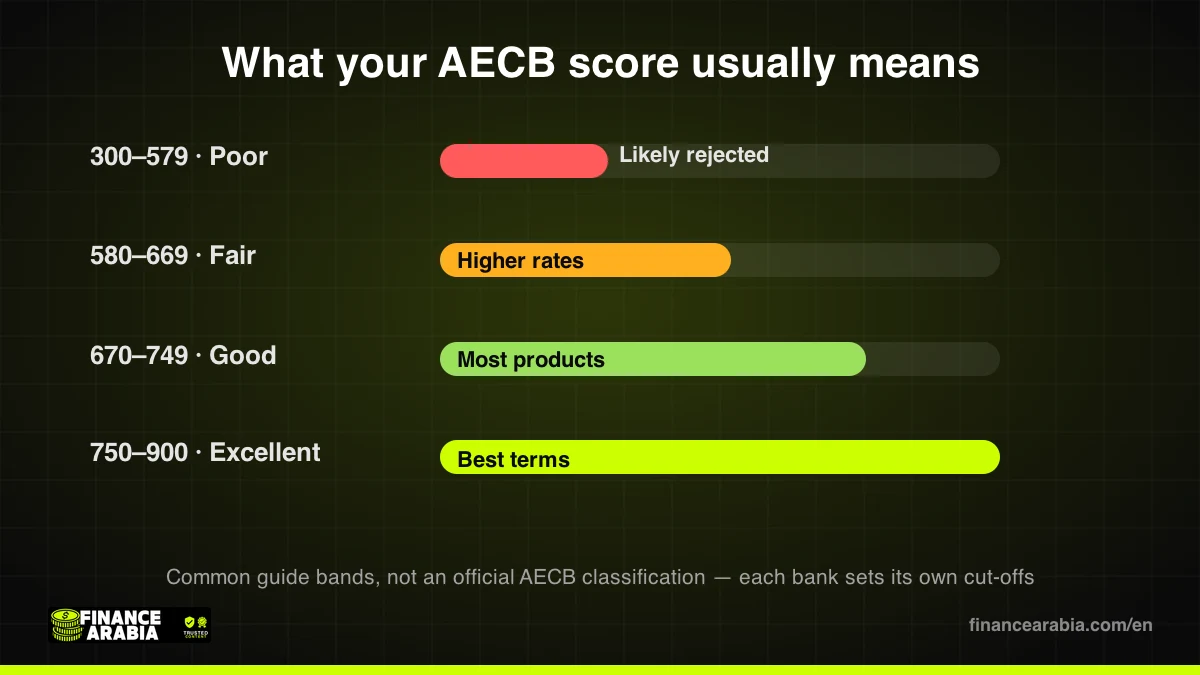
| Score | Rough rating | What it usually means |
|---|---|---|
| 300–579 | Poor | High risk: expect rejections or strict conditions |
| 580–669 | Fair | Possible approval, often at higher rates or lower limits |
| 670–749 | Good | Most mainstream products are open to you |
| 750–900 | Excellent | Best chance of approval and better terms |
These bands are a common guide, not an official AECB classification. Each bank sets its own cut-offs.
How to check your score (and what it costs)
| Channel | Score only | Score + full report |
|---|---|---|
| AECB app, website or TAMM | AED 10.50 | AED 84 |
| Customer happiness centres | AED 21 | AED 105 |
- Download the Al Etihad Credit Bureau app or go to the bureau's website. Dubai residents can also use DubaiNow, and Abu Dhabi residents can use TAMM.
- Register with your Emirates ID, mobile number and email address, then verify with UAE PASS or OTP.
- Choose score only or the full report, pay, and download it.
Score or report? If you just want to know where you stand, the score is enough. Before a big application like a mortgage, get the full report: it shows each account, your payment history over 36 months and your last reported salary, so you can spot errors.
What moves your score
| Factor | Impact | What to do |
|---|---|---|
| Paying on time | Biggest | Never miss a due date. Set up auto-pay for at least the minimum. |
| Credit card usage | High | Keep balances well under your limits. Below 30% is a common rule of thumb. |
| New applications | Medium | Don't apply to several banks at once. Each application is recorded. |
| Length of history | Medium | Keep your oldest well-managed card open. |
| Bounced cheques and defaults | Severe | Settle them, then make sure the record is updated. |
New in 2026: Tabby and Tamara count
From July 2026, the bureau includes buy now, pay later accounts from Tabby and Tamara in credit reports, including relevant historical data. This matters in two ways:
- It can help. If you're new to the UAE with no credit card, paying instalment plans on time can start building a record.
- It can hurt. Missed payments show up, and several open plans add to the monthly commitments a bank counts under the 50% debt burden ratio limit.
See how the two apps compare in our Tabby vs Tamara comparison.
A 90-day plan to improve your score
- Week 1: buy your full report and check every account, balance and late payment.
- Week 1–2: dispute any error through the bureau. One guide says corrections are free on a report bought within the last 30 days.
- Weeks 2–4: set up auto-pay on every card, loan and BNPL plan.
- Months 1–3: pay credit card balances down below about 30% of your limits, starting with the card closest to its limit.
- Throughout: don't apply for new credit unless you really need it.
- Day 90: check your score again. Real progress usually takes a few months of consistent behaviour.
Your score and your borrowing limit
A good score gets you approved, but your debt burden ratio decides how much you can borrow. UAE rules cap total monthly repayments at 50% of your salary, and personal loans at 20 times your salary over up to 48 months. Check your numbers with our DBR calculator and loan EMI calculator, and read our guide to UAE personal loans on your salary.
FAQs
Does checking my own score lower it?
No. Checking your own score or report doesn't hurt it. Only applications for credit are recorded.
I'm new to the UAE. Why don't I have a score?
You need some credit history first. A low-limit credit card, or a phone or BNPL plan paid on time, can start one over a few months.
Does my credit history from my home country count?
No. The UAE bureau only uses data reported in the UAE.
Do bounced cheques affect my score?
Yes. Returned cheques are reported and can seriously damage your score.
Information from the Etihad Credit Bureau and published guides, as of October 2026. Fees and procedures can change; check the bureau's official app or website. This article is for general information and is not financial advice.
Run the numbers yourself
Prices, fees and features change often. We check our facts at the time of writing, but always confirm the latest details with the provider. This article is for information only and is not financial advice.