Sending Money Home from the UAE: How to Get the Best Rate and Lowest Fees
"Zero fees" doesn't mean cheapest. How to compare remittance providers on the amount that actually arrives — and keep more of every dirham you send home.
By the Finance Arabia team4 min read
For millions of people in the UAE, sending money home is the most important transaction of the month. Yet many still pick a provider out of habit — and quietly lose part of every transfer to a weak exchange rate. This guide shows how remittance costs really work, how to compare providers in two minutes and how to keep your money safe. Use our currency converter to see today's mid-market rate for AED to INR, PKR, PHP, BDT, EGP and more.
The two costs in every transfer
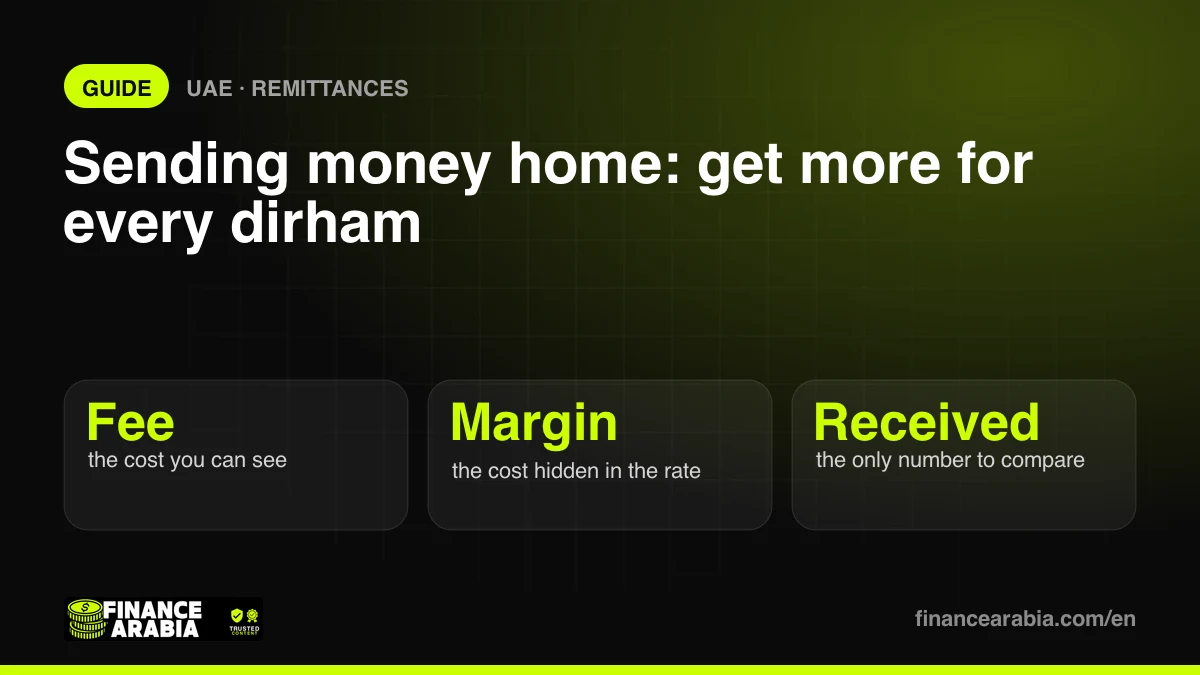
- The fee — the fixed amount you're charged per transfer. It's easy to see, so providers love to advertise "zero fees".
- The exchange-rate margin — the difference between the rate you're given and the real mid-market rate. It's hidden inside the rate, and it's usually the bigger cost.
A provider with "no fee" but a rate 1% worse than the market is more expensive on a AED 5,000 transfer than one charging a small fee at a near-market rate. The only number that matters is: how much arrives at the other end?
How to compare in two minutes
- Open our currency converter and note the mid-market rate for your currency pair.
- Get a quote from two or three providers for the exact amount you're sending.
- For each quote, write down the amount the recipient receives after all fees.
- Pick the highest — then check delivery speed and pick-up options.
| Example: sending AED 5,000 | Provider A | Provider B |
|---|---|---|
| Fee | AED 0 | AED 15 |
| Rate vs market | 1.0% below | 0.2% below |
| Hidden cost in the rate | About AED 50 | About AED 10 |
| Total cost | About AED 50 | About AED 25 |
Illustrative figures to show the method — real fees and margins vary by provider, amount and day.
Your options in the UAE
| Method | Pros | Watch out for |
|---|---|---|
| Exchange houses (branches and apps) | Huge networks, cash pick-up, fast transfers to South Asia and the Philippines | Rates and fees vary between branches and apps — compare |
| Bank transfers | Convenient from your salary account, good for large amounts | Some banks add high margins or correspondent fees on international transfers |
| Digital remittance apps | Transparent pricing, track transfers live | Check the app is licensed in the UAE and supports your destination bank |
Ways to pay less
- Send less often, in larger amounts — fixed fees hurt most on small transfers.
- Compare apps vs branch rates from the same provider — they're often different.
- Use promotions wisely: first-transfer offers are fine, but check the rate afterwards.
- Avoid card-funded transfers if your bank treats them as cash advances with extra charges.
- Don't chase daily rate moves: Gulf currencies are pegged to the US dollar, so your rate depends on how your home currency moves against the dollar. Small daily changes matter less than choosing a good provider.
Keep your money safe
- Use providers licensed by the Central Bank of the UAE. Licensed exchange houses and banks are listed on the CBUAE's public register.
- Never send money to someone you only know online, or in response to a message about a "prize", job fee or urgent family emergency you can't verify by phone.
- Double-check the recipient's name, account number and bank code — transfers to the wrong account are hard to reverse.
- Keep your receipts and transaction reference numbers.
Plan it, don't just send it
Regular remittances are often the biggest line in an expat budget after rent. Add them to our budget planner to see how they fit with saving for your own future — and if your family's savings sit in a high-inflation currency, check what they'll be worth in a few years with the inflation calculator.
FAQs
What is the mid-market rate?
The midpoint between the buy and sell rates on global currency markets — the "real" rate before any provider adds its margin. Our currency converter shows it.
Are remittances from the UAE taxed?
The UAE doesn't tax remittances or income. Whether the money is taxable for the recipient depends on the rules in the destination country.
What's the fastest way to send money home?
Exchange-house apps and digital providers often deliver to bank accounts or mobile wallets in South Asia and the Philippines within minutes. Bank wire transfers can take one to three working days.
The bottom line
The cheapest transfer isn't the one with no fee — it's the one where the most money arrives. Check the mid-market rate on our currency converter, compare the amount received from a few licensed providers, and you can keep more of every dirham you send home.
General information as of October 2026. Fees and exchange rates change constantly; always confirm the final amount with your provider before sending.
Prices, fees and features change often. We check our facts at the time of writing, but always confirm the latest details with the provider. This article is for information only and is not financial advice.