Crypto Staking Explained: How to Earn Rewards and the Risks to Know
Staking pays rewards for helping secure a blockchain. How it works, the ways to do it, and the risks that matter more than the headline rate.
By the Finance Arabia editorial team3 min read
Staking lets you earn rewards on certain cryptocurrencies by helping to secure their networks. It's often marketed as "passive income from crypto" — and it can be — but the rewards come with risks that many beginners don't understand until it's too late. Here's how staking works, where to do it and what can go wrong.
What is staking?
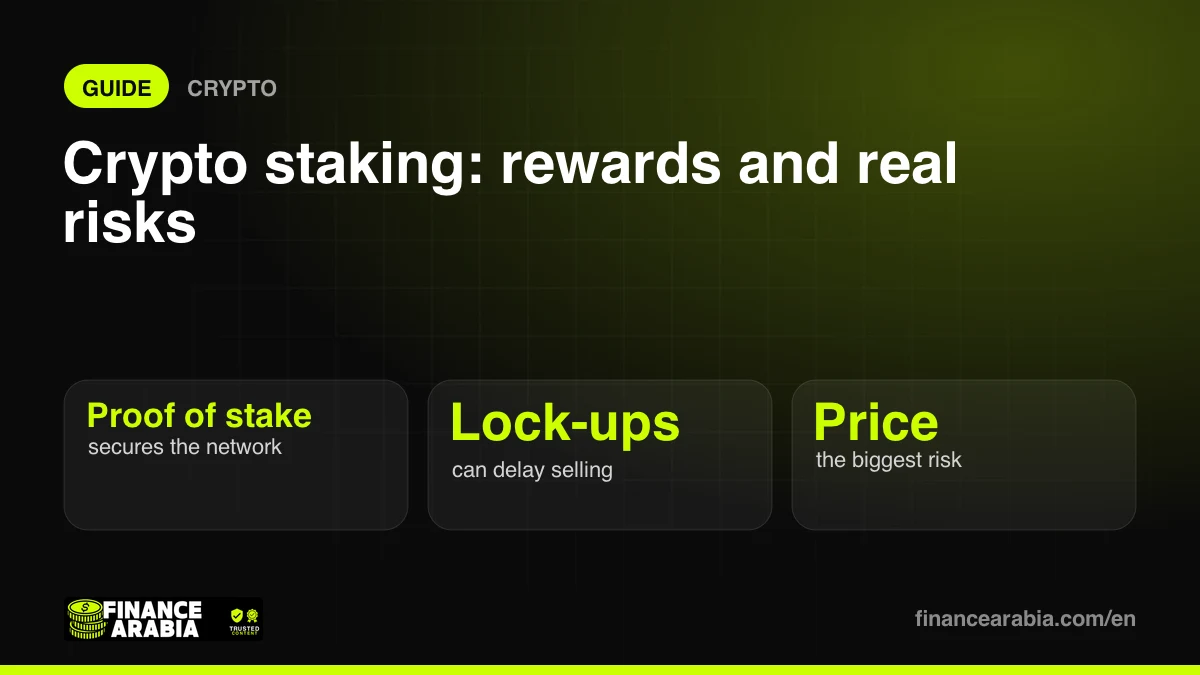
Many blockchains use proof of stake to agree on which transactions are valid. Instead of energy-hungry mining, participants lock up ("stake") coins as a security deposit. In return they earn new coins and a share of fees. If they act dishonestly or go offline, part of their stake can be cut ("slashed").
As a regular investor, you don't need to run anything yourself — you can stake through an exchange, a wallet or a staking service that does the technical work.
How it works, step by step
- You hold a proof-of-stake coin such as ETH, SOL, ADA or DOT.
- You delegate or deposit it to a validator, directly or through a platform.
- The validator helps secure the network and earns rewards.
- You receive your share of the rewards, minus the validator's or platform's fee.
Popular coins for staking
| Coin | Notes |
|---|---|
| Ethereum (ETH) | The largest proof-of-stake network. Withdrawals have been possible since 2023; liquid-staking tokens let you stake while keeping a tradable token. |
| Solana (SOL) | Delegate to validators from most wallets; rewards are usually higher than ETH but vary. |
| Cardano (ADA) | Delegate to a stake pool with no lock-up — your coins stay in your wallet. |
| Polkadot (DOT) | Uses nominated staking with an unbonding period of several weeks. |
| Polygon (POL, formerly MATIC) | Migrated from MATIC to POL in 2024; staking through validators. |
Reward rates change constantly with network conditions — check the current rate and fees on the platform you use. A higher advertised rate usually means higher risk.
Three ways to stake
| Method | Pros | Cons |
|---|---|---|
| Through an exchange | Easiest; a few taps | The exchange holds your coins; platform risk; fees |
| From your own wallet | You keep control of your keys | Slightly more technical; choose validators carefully |
| Run your own validator | Full control, no middleman fee | Technical, needs significant capital and uptime |
The risks
- Price risk: a 5% reward means little if the coin falls 50%. This is by far the biggest risk.
- Lock-up and unbonding periods: you may not be able to sell quickly when you want to.
- Platform risk: if an exchange or lending platform fails, staked coins can be lost or frozen — this has happened.
- Slashing: poorly run validators can lose part of the stake.
- Smart-contract risk with liquid staking and DeFi products.
- Regulation: rules on crypto and staking differ by country and change often.
Tips for staking safely
- Only stake coins you'd be happy to hold long term anyway.
- Use platforms regulated where you live — in the UAE, look for VARA or ADGM-regulated providers.
- Be very sceptical of "guaranteed" high yields — see our scam warning signs.
- Spread across validators or platforms rather than putting everything in one.
- Keep crypto to a small share of your overall investments.
Is staking halal?
Scholars differ. Some view staking rewards as payment for a service (validating transactions) rather than interest, while others have reservations about certain coins and products. If this matters to you, consult a trusted Sharia authority — and avoid lending-based "earn" products, which work differently from staking. See also our Ethereum review.
The bottom line
Staking can add a modest income stream to crypto you already plan to hold. It doesn't remove crypto's volatility, and the platform you choose matters as much as the reward rate.
General information only, not investment advice. Crypto is highly volatile and you can lose your entire investment.
Prices, fees and features change often. We check our facts at the time of writing, but always confirm the latest details with the provider. This article is for information only and is not financial advice.