10 Warning Signs a "Get Rich Quick" Offer Is a Scam
Fake part-time jobs, "guaranteed" crypto returns and task scams target Gulf residents daily. Ten red flags that give them away — and what to do if you've been caught.
By the Finance Arabia editorial team4 min read
"Earn $5,000 a month from your phone." "Guaranteed 3% a day on crypto." "Part-time job: just like videos and get paid." If you live in the Gulf, you've almost certainly received messages like these on WhatsApp, Telegram or Instagram. Most of them are scams designed to take your money or your identity. Here are the ten warning signs that give them away — and what to do if you've already been targeted.
Why these scams work
They target a real need: extra income. Scammers know that many people are supporting families, paying off loans or saving for the future, and they wrap their pitch in the language of opportunity. They often start small — a genuine-looking payment for a simple task — to build trust before asking for much more.
The 10 warning signs
1. Returns that are too good to be true
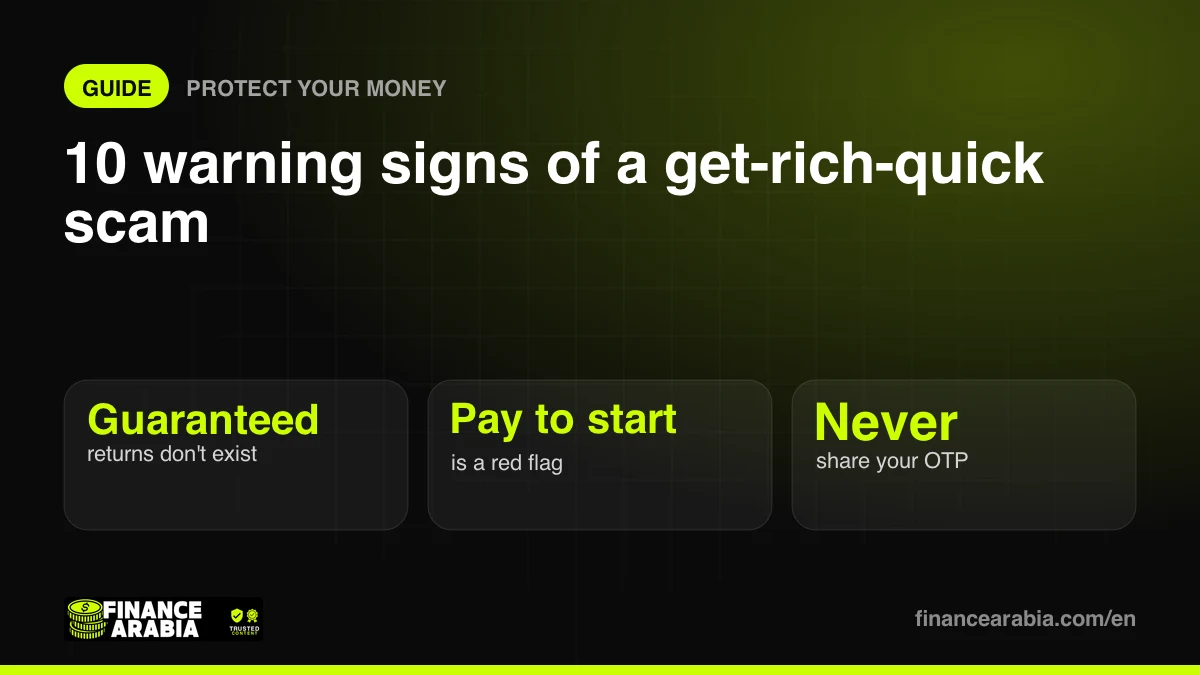
No legitimate investment guarantees high returns, and no real job pays thousands for a few minutes a day with no skills. Anything promising "guaranteed" or "risk-free" profit is the biggest red flag of all.
2. You have to pay to start
Registration fees, "activation" deposits, mandatory courses or "upgrading your account level" — real employers pay you, not the other way round.
3. Vague explanations of how the money is made
"Our AI trading system," "a secret algorithm," "exclusive arbitrage" — if you can't explain in one sentence where the profit comes from, walk away.
4. Fake proof and testimonials
Screenshots of payouts, luxury cars and glowing reviews are easy to fake or generate with AI. They prove nothing.
5. Pressure to act now
"Only 3 places left," "offer ends tonight," "deposit in the next hour to lock in your bonus." Urgency is designed to stop you thinking clearly or asking someone else.
6. No verifiable company behind it
Look for a registered company, a physical address and a licence. In the UAE, investment and trading firms should be licensed by the relevant regulator (such as the SCA, DFSA or FSRA); in Saudi Arabia, by the Capital Market Authority (CMA) or SAMA. If you can't find them on the regulator's public register, don't send money.
7. Your income depends on recruiting others
If you earn more from bringing in friends than from selling a real product, it's a pyramid or Ponzi scheme. These collapse — and the last people in lose everything.
8. Requests for personal or banking details
Never share your card PIN, one-time passwords (OTPs), online banking login, or photos of your Emirates ID, Iqama or passport with someone you met online. Banks and government entities will never ask for your OTP.
9. A slick website with nothing behind it
Professional templates are cheap. Check how long the domain has existed with a WHOIS lookup — a site created a few weeks ago that claims years of success is lying.
10. You can't withdraw
Many "investment" platforms show your balance growing beautifully, until you try to take money out. Suddenly there's a "tax", "unlock fee" or "verification deposit". Paying it never releases your money; it only makes the loss bigger.
How to protect yourself
- Search before you pay: type the company name plus "scam" or "review" into a search engine.
- Check the regulator's register before investing with anyone.
- Talk to someone you trust before sending money. Scammers rely on secrecy.
- Take your time. Real opportunities don't vanish in an hour.
- Turn on two-factor authentication for email, banking and social media.
Already sent money? Act fast
- Call your bank immediately and ask them to block your card and try to stop or recall the transfer.
- Stop all contact and don't pay any "recovery" fee — "fund recovery" services are often the same scammers again.
- Report it. In the UAE, use the police e-crime services (such as Dubai Police's e-Crime platform or Abu Dhabi Police's Aman service). In Saudi Arabia, report through the Kollona Amn app or your bank.
- Keep evidence: screenshots, transaction references, phone numbers and usernames.
The bottom line
Making money online is real — but it takes skills, time and patience. Anyone promising fast, guaranteed, effortless profit is selling a trap. As the saying goes: if it sounds too good to be true, it is.
Prices, fees and features change often. We check our facts at the time of writing, but always confirm the latest details with the provider. This article is for information only and is not financial advice.