Ethereum (ETH) Review: How It Works, Strengths, Risks and Who It's For
Ethereum isn't just a coin — it's infrastructure for an entire industry. A plain-English review of how it works, its strengths, its risks and how it stacks up.
By the Finance Arabia team4 min read
Bitcoin is usually called "digital gold". Ethereum is better described as a "world computer" — a network running thousands of applications that no single company owns. That difference isn't a technical footnote: it shapes what the coin is worth, what can go wrong and where it might be heading. This review explains the project in plain English, lays out its strengths and weaknesses, and looks at who it makes sense for.
Quick verdict
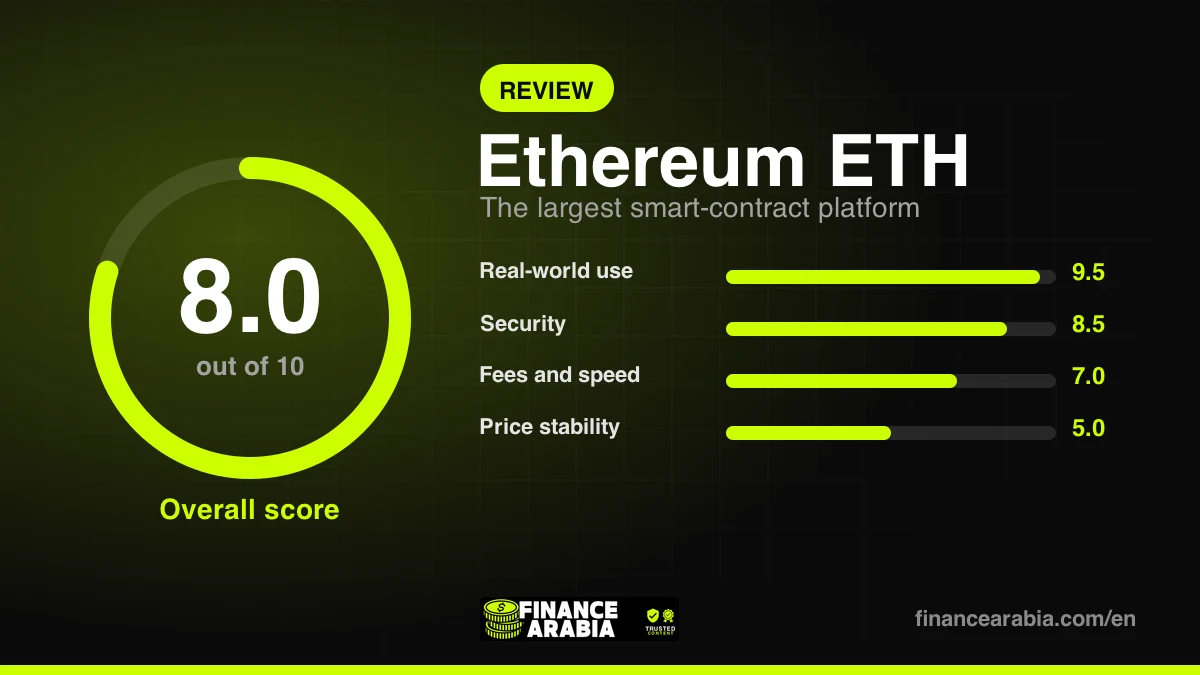
| Overall score | 8.0 / 10 |
|---|---|
| Best for | Long-term holding, sized sensibly |
| Biggest strength | Biggest app and developer ecosystem |
| Biggest drawback | Extreme price swings |
| Real-world use | 9.5 / 10 |
| Security | 8.5 / 10 |
| Fees and speed | 7.0 / 10 |
| Price stability | 5.0 / 10 |
What is Ethereum?
Ethereum is a blockchain network launched in 2015 by Vitalik Buterin and his co-founders. Its native coin is called ether (ETH). The core idea is the smart contract: a program that runs automatically on the network when certain conditions are met, with no middleman. Decentralised finance (DeFi), stablecoins such as USDT and USDC, NFTs and thousands of other apps are built on that idea.
Every transaction on the network pays a fee in ether, known as "gas". That ties demand for the coin to actual use of the network — something many other cryptocurrencies, with no real use case, simply don't have.
Key milestones
| Year | Event | Why it matters |
|---|---|---|
| 2015 | Network launch | The first widely used smart-contract platform |
| 2021 | London upgrade (EIP-1559) | Part of every fee is burned, so supply now responds to usage |
| 2022 | The Merge | Switched from mining to proof of stake, cutting energy use by more than 99% |
| 2024 | Dencun upgrade | Sharply lower fees on layer-2 networks |
| 2024 | US spot ETH ETFs approved | Easy access for institutions and traditional investors |
| 2025 | Pectra upgrade | Improvements to wallets and staking |
Strengths
- The biggest app ecosystem: most DeFi activity and stablecoins run on Ethereum or on networks built on top of it.
- The largest developer community: which means constant upgrades and fixes for the network's problems.
- Staking income: holders can stake ETH to help secure the network in return for a variable annual yield.
- Institutional acceptance: regulated ETFs have made ether part of mainstream investment portfolios.
Risks and weaknesses
- Extreme volatility: like every cryptocurrency, it can lose half its value within months.
- Strong competition: networks such as Solana offer faster transactions and lower fees on their main chain.
- Main-network fees: they're tiny on layer 2, but can spike on the main chain when it's busy.
- Complexity: the number of layer-2 networks confuses new users when sending funds.
Ethereum vs Bitcoin vs Solana
| Feature | Bitcoin | Ethereum | Solana |
|---|---|---|---|
| Main purpose | Store of value | Apps and smart contracts | High-speed app platform |
| Consensus | Proof of work (mining) | Proof of stake | Proof of stake + proof of history |
| Maximum supply | 21 million | No fixed cap | No fixed cap |
| Speed and fees | Slower | Moderate (faster and cheaper on layer 2) | Fast and cheap |
| App ecosystem | Limited | The largest | Large and growing |
Is Ethereum halal?
Scholars and Sharia boards disagree about cryptocurrencies in general. Many Islamic finance researchers see Ethereum as closer to acceptable than coins with no real use, because it is a network with genuine utility — with reservations about some apps built on it, such as interest-based lending. If this matters to you, check with a trusted Sharia authority before investing, and avoid lending and leveraged products.
Who should invest in Ethereum?
It suits people who believe in the future of decentralised apps and invest for years rather than weeks, and those who want to diversify a crypto portfolio beyond Bitcoin.
It doesn't suit anyone who needs the money soon or can't stomach watching their portfolio drop sharply. The golden rule: only put into crypto what you can afford to lose, ideally a small slice of your total investments.
FAQs
What's the difference between Ethereum and ether?
Ethereum is the network; ether (ETH) is the coin used on it to pay fees and to stake.
Can you still mine Ethereum?
No. Mining ended with the move to proof of stake in 2022. Staking replaced it.
How do I buy Ethereum safely in the UAE or Saudi Arabia?
Use a platform licensed in your country — in the UAE, look for exchanges regulated by VARA or the ADGM — or a well-known global exchange. Move larger amounts to a personal wallet where you control the keys, and switch on two-factor authentication.
The verdict
Ethereum isn't just a coin; it's infrastructure for an entire industry. Its strength is real-world usage and a huge community; its risks are volatility and competition. As a long-term holding sized sensibly within a portfolio, it remains one of the most established projects in crypto. As a short-term bet, it's like everything else in the space: big upside, bigger risk.
This content is educational and is not a recommendation to buy or sell. Crypto prices are highly volatile — speak to a licensed financial adviser before investing.
Prices, fees and features change often. We check our facts at the time of writing, but always confirm the latest details with the provider. This article is for information only and is not financial advice.