Al Ansari vs LuLu Money: A Practical Remittance Guide for UAE Expats and Workers
Compare Al Ansari and LuLu Money by fees, exchange rates, net payout, sign-up, salary-card funding and cash access, with official links and worked examples.
By the Finance Arabia editorial team8 min read
Al Ansari Exchange or LuLu Money: which should you use to send part of your salary home? The answer depends on the destination, delivery method, exchange rate and charges for the transfer you actually make. The useful comparison starts with your total spending and the amount your family can use—not a “low fees” headline in isolation.
Quick verdict: obtain a final quote from both services for the same total budget, recipient and receiving method. Choose the combination of net payout, timing and access that fits your household, then check again next month. This guide covers personal transfers from the UAE. Its comparison method is useful across the Gulf, but UAE eligibility and fees must not be applied automatically to Saudi Arabia, Kuwait, Qatar, Oman or Bahrain.
The two services at a glance
| Question | Al Ansari Exchange | LuLu Money / LuLu Exchange |
|---|---|---|
| Product compared | Personal remittance from the UAE, app or branch | Personal remittance from the UAE, app or branch |
| Receiving options | Bank, cash or wallet where available | Bank, cash or wallet where available |
| Digital joining route | App page describes UAE PASS and eKYC | FAQ describes registration and verification; a branch may be needed |
| Price | Depends on destination, amount, service and channel | Depends on destination, amount, service and channel |
| Who wins on cost? | Determined by the current final quote | Determined by the current final quote |
| Worker-friendly test | Accepted funding and practical recipient access | Accepted funding and practical recipient access |
You are buying access to money at the other end
The receiving account and payout method are part of the product. A recipient close to a cash partner may prefer collection, while someone paying bills through a banking app may need a deposit. Do not assume a domestic mobile wallet accepts every overseas transfer, or that a bank’s name is enough to identify the destination account.
We compare a remittance funded with your available money. A salary card, wallet account, loan or investment product offered nearby in an app is a separate product with separate terms. Switching products during onboarding can introduce costs or eligibility conditions that were not part of your initial comparison.


When Al Ansari is worth checking first
It is a practical candidate when its branch or digital route is convenient and your family’s preferred receiving method is supported. Its remittance service page describes identity and beneficiary requirements, with source-of-funds information potentially needed depending on the transfer. Its app page describes a UAE PASS registration route without a branch visit where available. That is not a guarantee of approval or of avoiding additional checks.
Compare the app and branch quote for the same service instead of assuming they are identical. Keep the beneficiary’s legal name and bank-confirmed account details ready. For cash collection, ask about the actual paying network and opening hours, rather than relying on the sender-side brand alone.

When LuLu Money is worth comparing
LuLu Money is LuLu Exchange’s digital channel. The UAE FAQ describes registration with email, mobile number and Emirates ID, followed by verification; some cases may require a branch visit. Follow the route shown for your application rather than assuming all new customers can complete every step remotely.
Identify the exact product. LuLu’s newer wallet terms are not automatically the tariff for a traditional remittance, and balance, funding and spending limits can differ. We therefore do not assign one daily limit to every LuLu product or assume a payment method visible in the app works for every destination.
Fees and exchange rates: why there is no permanent winner
Al Ansari’s Key Facts Statement page links its remittance document: match the country and service row to your transaction. LuLu’s published remittance KFS describes variable fees and potential intermediary or receiving-bank charges. Its international-bank-transfer section lists a broad AED 0–180 or more range including VAT, depending on the amount, destination and currency. That is a document range, not the usual price of every worker’s transfer.
Comparing unrelated maximum fees does not establish a winner. Use the final pre-payment quote, including tax, funding charges and known deductions at the receiving end. The CBUAE disclosure standard addresses advance disclosure of exchange rates, charges and expected beneficiary amounts. Ask for a clear breakdown if any component is unclear.
| Cost component | Question to ask |
|---|---|
| Sending fee | What is the actual amount, and is VAT included? |
| Exchange rate | Which currency, converted amount and rate-lock point apply? |
| Funding | Does the payment channel, card issuer or bank add a charge? |
| Receiving side | Is a bank, intermediary or cash-pickup deduction disclosed? |
| Total | What leaves my funds, and what is the expected net payout? |
Worked example: zero fee can still deliver less
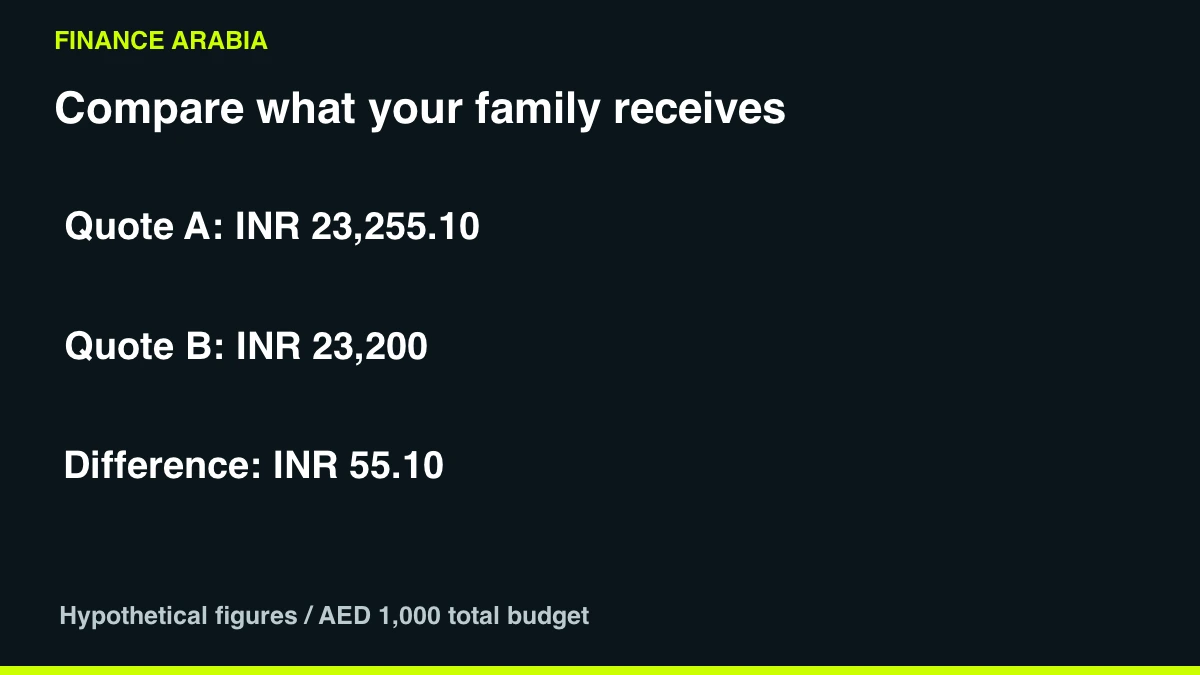
Assume an AED 1,000 total budget, fees deducted from it and no additional deductions. The figures below are invented to explain the calculation. Quotes A and B are not Al Ansari or LuLu quotes and do not represent a live exchange rate.
| Calculation | Hypothetical quote A | Hypothetical quote B |
|---|---|---|
| Total budget including fees | AED 1,000 | AED 1,000 |
| Assumed all-in fee | AED 10 | Zero |
| Amount converted | AED 990 | AED 1,000 |
| Assumed INR per AED | 23.49 | 23.20 |
| Expected recipient payout | INR 23,255.10 | INR 23,200 |
| Result | INR 55.10 more despite the fee | Zero fee, lower payout |
Use: (total budget − fees within that budget) × exchange rate − known additional deductions. If fees are added above the amount sent, adjust the principal so both quotes still use the same total spending. A hypothetical avoidable AED 8 difference on each of twelve monthly transfers adds up to AED 96 a year, but that is arithmetic—not a savings promise about either provider.
How to join and send with Al Ansari
- Open the official app page and follow the relevant store link, or use an official branch if that suits your circumstances.
- Check digital-channel eligibility terms for your age, residence and chosen product. Have valid identification and access to the mobile number used for verification.
- Create the profile and complete the offered UAE PASS or eKYC flow. Provide additional documents or visit a branch if requested.
- Add the recipient and receiving method. Match the legal name and account details against a trusted record.
- Obtain a final quote and choose an accepted funding method. Review the total debit, expected payout and timing before paying.
- Save the receipt and reference, then ask the recipient to confirm the actual accessible amount.
How to join and send with LuLu Money
- Start from the official UAE page and download through its store links, choosing the correct sending country.
- Register the requested mobile, email and identity information. Complete any branch or ID-update step before sending a substantial amount.
- Add the beneficiary and payout destination. Read the first-transfer conditions and the limit shown for your account rather than relying on an advertisement.
- Compare fees, rate and expected delivery using the same transfer specification as your Al Ansari quote.
- Choose a payment method accepted for this transfer and verify its funding cost and your available balance.
- Save the reference and follow the status. Do not resend simply because processing is still underway.
What if you do not have a conventional bank account?
If you receive wages in cash or on a payroll card, do not assume the app accepts that card or that using it has no cost. Ask about cash funding at a branch or another supported method for your specific product. A recipient without a bank account may be able to collect cash where supported, but identification, the paying network and the cost of reaching a branch still matter.
For a domestic worker or shift worker, travel time can cost more than a small saving in the fee. Include transport, opening hours and whether your family must miss work to collect the money. Never give a colleague your PIN or one-time code to complete a transfer, and do not send to a private account promising an off-platform special rate.
Which service fits each situation?
| Need | Decision test |
|---|---|
| Monthly household transfer | Compare net payout at equal total spending each month |
| Urgent school or medical payment | Confirm the actual route and receiving time before chasing a minor rate difference |
| Recipient without a bank account | Verify cash-network name, location and required ID |
| Funding from a salary card | Confirm acceptance and charges explicitly |
| Cash wages or difficult onboarding | Ask an official branch which verification and funding route is available |
| Working elsewhere in the GCC | Use the locally authorised entity; UAE terms do not establish eligibility there |
Delays and refunds: prepare a follow-up route
Before sending an important payment, record the official support channel and required transfer reference. If it is delayed, ask whether the receiving bank needs more information. Do not assume cancellation is immediate or that a refund restores the sending fee and original exchange rate. LuLu’s terms discuss account details and receiving-side charges; read the agreement applicable to your actual provider and transaction as well.
Retain the receipt, final quote, contact times and complaint reference. “Sent” is not always the same as “available to the recipient.” Avoid borrowing for a recurring remittance without a clear repayment plan; arrange your household budget so regular family support does not create a persistent shortfall for you. If you plan to invest what remains, use our GCC and US stock-platform comparison after reserving essential commitments.
Frequently asked questions
Which is cheaper, Al Ansari or LuLu?
There is no permanent winner. Compare net payout using the same total budget, timing and receiving method.
Are the INR examples current rates?
No. They are hypothetical calculations and are not assigned to either company.
Are app and branch conditions identical?
Not necessarily. Eligibility, funding, fees, channel and product may differ; check the specific transaction.
Does this guide cover every GCC country?
The net-payout method is broadly useful, but the cited product conditions are for the UAE and do not prove eligibility elsewhere.
Last reviewed: 19 November 2026. No live exchange-rate quotes are included; confirm eligibility and the final offer before transferring.
Run the numbers yourself
Prices, fees and features change often. We check our facts at the time of writing, but always confirm the latest details with the provider. This article is for information only and is not financial advice.