Botim Money Review for UAE Workers: Fees, Exchange Rates and Sending Salary Home
A practical guide for UAE workers sending money home: Botim Money eligibility, fees, exchange rates, payout comparisons and a step-by-step transfer checklist.
By the Finance Arabia editorial team7 min read
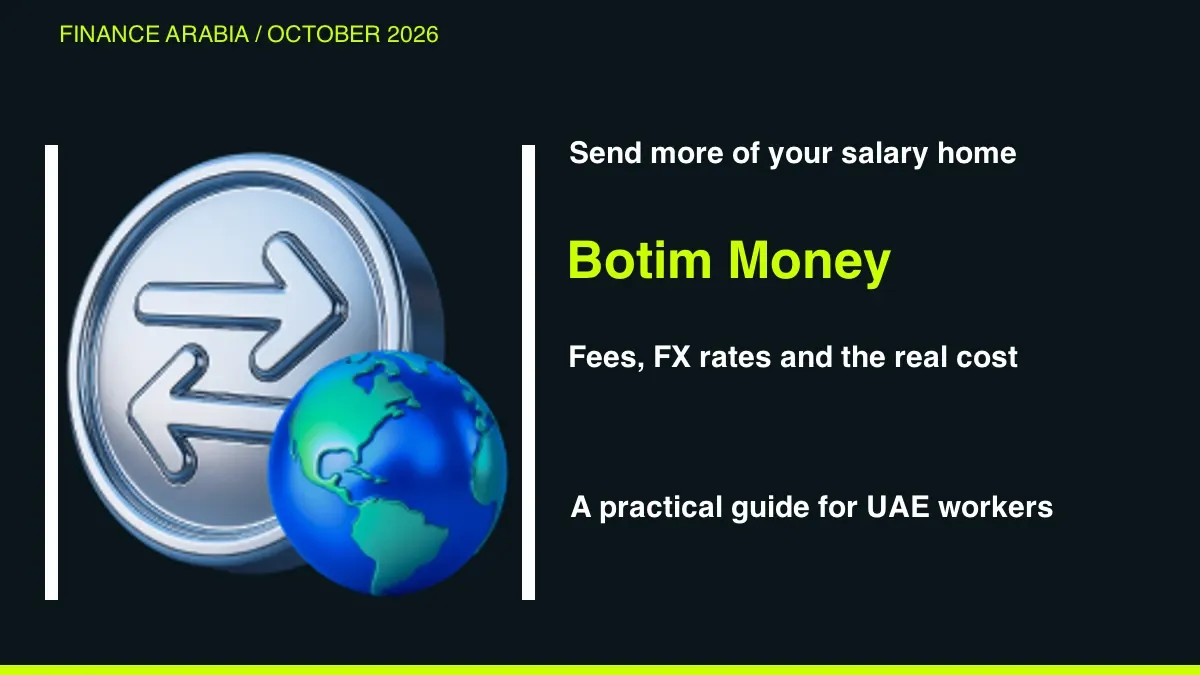
Sending part of your salary home is a regular expense for many people working in the Gulf. The useful question is not simply whether a money-transfer app advertises a low fee: it is how much your family receives for the same total amount you spend. Botim Money is one option for eligible UAE residents, but its value depends on the destination, funding method and exchange rate shown for your transfer.
Our verdict: consider Botim Money alongside a licensed exchange house or your bank, using a fresh quote for the same recipient and delivery method. Choose it when the final payout, timing and practical access suit your family. This is a document-based product guide, not a hands-on transfer test or a claim that Botim is always cheapest.
Who is this product for?
Botim's international-transfer service sends money from the UAE. Living elsewhere in the Gulf does not automatically make you eligible: a UAE product should not be treated as a Saudi, Kuwaiti, Qatari, Bahraini or Omani account. The provider's Key Facts Statement lists eligibility as UAE residents or citizens aged 18 or over and requires identity documentation, including Emirates ID. The wallet operates in AED.
| Your situation | Practical starting point |
|---|---|
| Employed and resident in the UAE | Check eligibility and obtain an in-app quote for your destination. |
| Working in another GCC country without UAE residency | Start with providers authorised to serve residents of your country. |
| Your family needs cash rather than a bank deposit | Check the actual pickup option, location and identification requirements. |
| You need to send money before payday | Treat any borrowing offer as a separate credit decision, not an ordinary remittance. |

The costs to check before sending your salary
The published schedule, effective 4 September 2026, lists international-transfer fees of AED 4.99–15, excluding VAT, depending on the destination and delivery method. Separately, wallet funding by bank transfer is listed as free, while debit or prepaid card funding can cost up to 1%. Those are different charges: a cheap transfer can still become more expensive through the way you fund it.
| Cost layer | What to inspect | Why it matters |
|---|---|---|
| Wallet funding | The charge for the funding method actually offered to you | This can arise before the international transfer begins. |
| Transfer service fee | Destination-specific fee and applicable VAT | An advertised starting fee is not your final quote. |
| Currency conversion | The quoted rate and recipient's final payout | A lower fee can be offset by a weaker exchange rate. |
| Receiving-side costs | Any disclosed partner or recipient-bank charges | Your family may care about the amount accessible after receipt. |
Do not assume that every wallet funding option can be used for every remittance. The provider's international-transfer FAQ says credit cards are not currently supported for transfers, while its broader wallet documents describe credit-card funding. Check the specific transfer flow and ask support if the information appears inconsistent. A general wallet feature is not proof that a particular remittance will accept it.
A worked example: the lower fee can lose
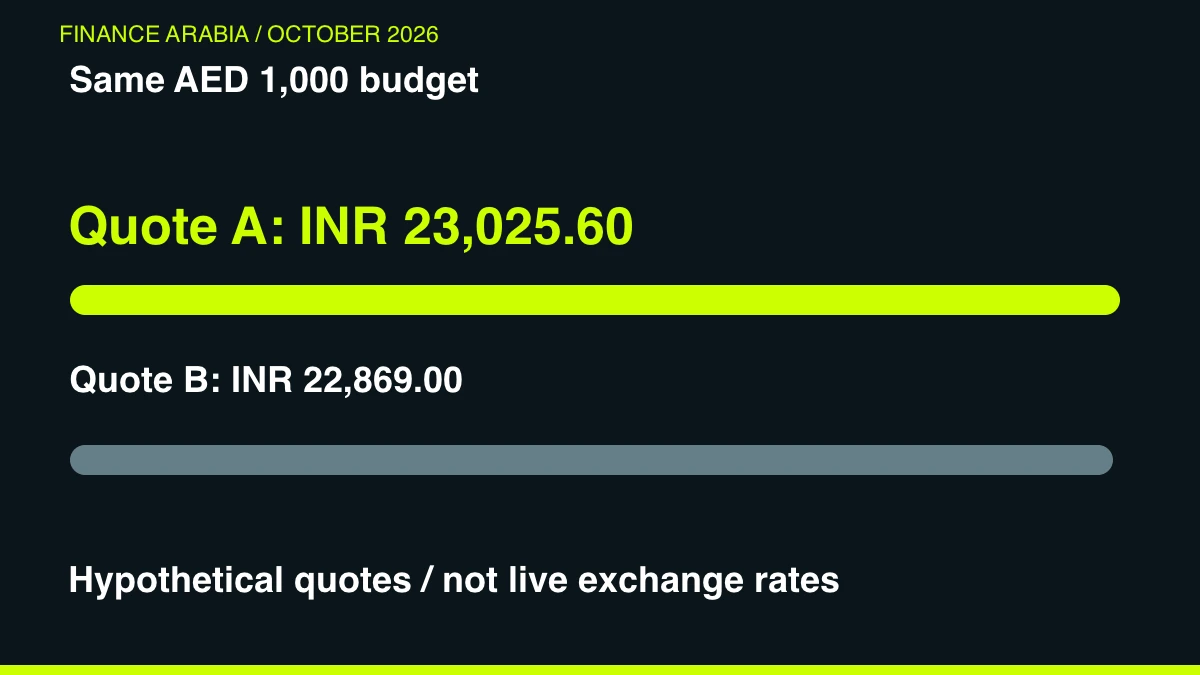
Suppose you have a total budget of AED 1,000, including fees, and are comparing two quotes to India. The rates and fees below are invented solely to demonstrate the calculation. Neither column is a live Botim quote or an offer from another named provider.
| Calculation | Hypothetical quote A | Hypothetical quote B |
|---|---|---|
| Total budget | AED 1,000 | AED 1,000 |
| All-in sending fee assumed | AED 16 | AED 10 |
| Amount converted | AED 984 | AED 990 |
| Assumed rate per AED | INR 23.40 | INR 23.10 |
| Recipient payout | INR 23,025.60 | INR 22,869.00 |
| Result | INR 156.60 more received | Lower fee, lower payout |
The calculation is: (total budget − all-in fees paid from that budget) × exchange rate = recipient payout, assuming no further deductions. Quote A wins this example despite charging a higher sending fee. In a real comparison, keep the total spend, time of quote, destination and delivery method identical. If a fee is added on top rather than taken from your budget, adjust the sending amount before comparing.
How to prepare and check a transfer
- Verify your own account. Complete the identity checks in the official app. Keep your identification and contact details current.
- Agree the receiving method with your family. A bank deposit and cash pickup solve different problems. Confirm that the recipient can actually access the selected option.
- Copy details from a trusted record. Check the recipient's legal name and required account identifiers. Reconfirm changed bank details through a separate, trusted conversation.
- Obtain a quote before committing. Record the total AED debit, payout currency, final recipient amount, fees and estimated delivery.
- Compare one alternative. Request a quote with the same total budget and delivery method. A headline rate for a different amount is not a fair comparison.
- Review, then submit. Recheck the beneficiary and funding source. Save the receipt and transaction reference after payment.
- Confirm receipt. Ask your family to verify the credited amount or completed collection, rather than relying only on your app notification.
The provider's FAQ describes bank, wallet, cash-pickup and UPI options with availability varying by destination. It also explains that receiving-bank checks and holidays can delay delivery. Do not equate an immediately processed request with money being available immediately at the other end.
Make monthly remittances fit your budget
Decide what you can send after reserving rent, transport, food and your upcoming bills. A successful transfer should not leave you short of essentials before the next payday. If the recipient needs a fixed amount in their currency, obtain the quote for that target amount and check the total AED cost; do not assume last month's salary allocation will buy the same payout.
| Monthly habit | What to record |
|---|---|
| Before payday | Expected family needs and bills due in both households. |
| When comparing providers | Total AED cost, recipient payout, delivery method and quote time. |
| After transfer | Receipt, reference and the amount actually received. |
| Before repeating next month | Updated rate, fees and any change to beneficiary details. |
For example, an extra AED 10 in avoidable cost on each of 12 monthly transfers adds up to AED 120 a year. This is simple arithmetic, not a forecast of savings with a particular app. Combining transfers may reduce repeated fixed fees, but only when your family's timing, your cash flow and the applicable limits make it sensible. Do not delay essential household money merely to chase a small fee saving.
What if a transfer goes wrong?
Keep the transaction reference and contact the provider through its official support channel promptly. Its Key Facts Statement warns that cancellation cannot be guaranteed after initiation and that fees may not be returned even when a cancellation succeeds. It also states that the wallet is not a bank account and is not covered by a deposit protection scheme. Those distinctions matter when deciding how much money to leave in the wallet between transfers.
The published FAQ and Key Facts Statement give different refund timelines for some routes. Rather than promising one deadline, ask support which timeline applies to your payment method and case. Avoid sending the same transfer again while the first remains unresolved: a delay is not proof of failure, and a second payment can create an unintended duplicate.
Frequently asked questions
Is Botim Money automatically the cheapest way to send money home?
No. Compare the final recipient payout for the same total AED spend. The destination, funding method, exchange rate and delivery option can change the result.
Can all Gulf residents use this UAE product?
Do not assume so. The cited eligibility is for UAE residents or citizens aged 18 or above. Check providers serving your actual country of residence.
Are the INR figures in this article today's rates?
No. They are hypothetical examples showing how fees and exchange rates interact. Get a fresh in-app quote before making a decision.
Can I reverse a transfer if I entered the wrong account?
Do not rely on reversal. Contact official support immediately; recovery or cancellation is not guaranteed.
Sources checked on 25 October 2026: Botim Money Key Facts Statement, Schedule of Charges and International Transfer FAQ, linked above. Fees and product availability can change. This article covers ordinary funded remittances; borrowing and pay-later products require a separate assessment.
Run the numbers yourself
Prices, fees and features change often. We check our facts at the time of writing, but always confirm the latest details with the provider. This article is for information only and is not financial advice.