Angel Investing for Beginners: How to Invest in Startups Sensibly
Investing in early-stage startups can be rewarding — and is one of the riskiest things you can do with money. How to approach it sensibly.
By the Finance Arabia editorial team3 min read
Angel investing means putting your own money into early-stage startups in exchange for a share of the company. The Gulf startup scene has grown quickly, and more professionals are being invited to "get in early". It can be rewarding — and it's one of the riskiest things you can do with your money. Here's how it works and how to approach it sensibly.
What is an angel investor?
An angel is an individual who invests in a startup at its earliest stages — often before it has much revenue — usually in exchange for shares or a convertible instrument such as a SAFE or convertible note. Angels often bring experience and contacts as well as cash.
Why people do it
- Potential for large returns if a company succeeds — a single big winner can make a portfolio.
- Supporting founders and the local ecosystem.
- Learning how businesses are built from the inside.
The risks you must accept
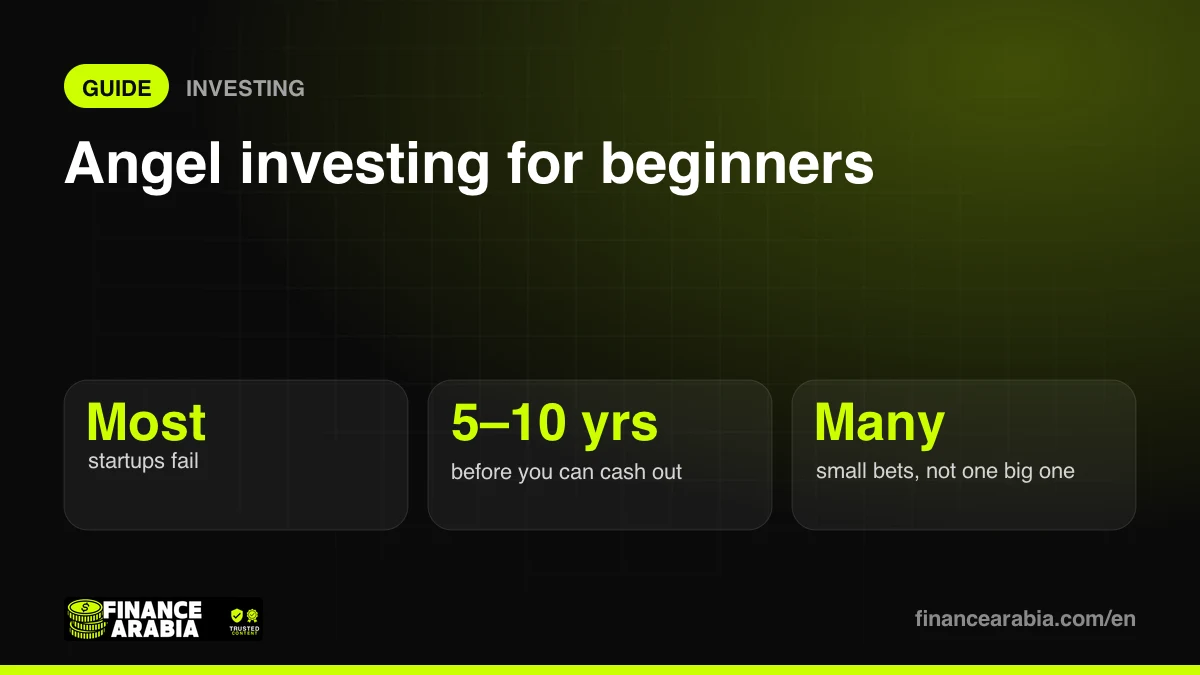
- Most startups fail. Assume many of your investments will go to zero.
- Your money is locked up for years — often 5 to 10 — with no easy way to sell.
- Dilution: later funding rounds reduce your percentage ownership.
- Limited information compared with listed companies.
Are you ready? A quick self-check
- You have a full emergency fund and no expensive debt.
- Your long-term investing (retirement, children's education) is already on track.
- You can afford to lose every dirham you put into startups without it affecting your life.
- You can spread money across many startups, not just one or two.
A common guideline is to keep angel investments to a small slice of your total investable wealth.
How to evaluate a startup
| Area | Questions to ask |
|---|---|
| Team | Do the founders have relevant experience? Are they committed full-time? Can they attract talent? |
| Problem and solution | Is the problem real and painful? Are customers already paying for something similar? |
| Market | Is the market big enough? Why is now the right time? |
| Business model | How does it make money? What do customers cost to win, and what are they worth? |
| Competition | Who else is doing this? What's genuinely hard to copy? |
| Terms | What's the valuation? What rights do you get? How will future rounds affect you? |
How to get started
- Learn first: read up on startup terms — valuations, SAFEs, dilution, liquidation preferences.
- Join an angel network or syndicate. Many exist across the UAE and Saudi Arabia; you invest alongside experienced angels who lead due diligence.
- Consider regulated crowdfunding platforms that let you invest smaller amounts in vetted startups — check they're licensed by the relevant regulator.
- Start small and build a portfolio gradually.
- Get the paperwork reviewed by a lawyer for larger cheques.
Key documents you'll see
- Pitch deck — the founders' story and plan.
- Term sheet — the main terms of the investment.
- Shareholders' agreement — rights and obligations of all shareholders.
- Cap table — who owns what.
- SAFE or convertible note — common for very early rounds.
Golden rules
- Never invest because of pressure or fear of missing out.
- Diversify across many companies and sectors.
- Invest in areas you understand.
- Keep money aside for follow-on rounds in your winners.
- Be patient — exits take years.
The bottom line
Angel investing can be exciting and occasionally very profitable, but it belongs at the edge of a financial plan, not the centre. Get your foundations right first, invest small amounts across many startups, and only with money you can afford to lose.
General information only, not investment advice.
Prices, fees and features change often. We check our facts at the time of writing, but always confirm the latest details with the provider. This article is for information only and is not financial advice.