ETFs Explained: Types, How to Invest and What Gulf Investors Should Know
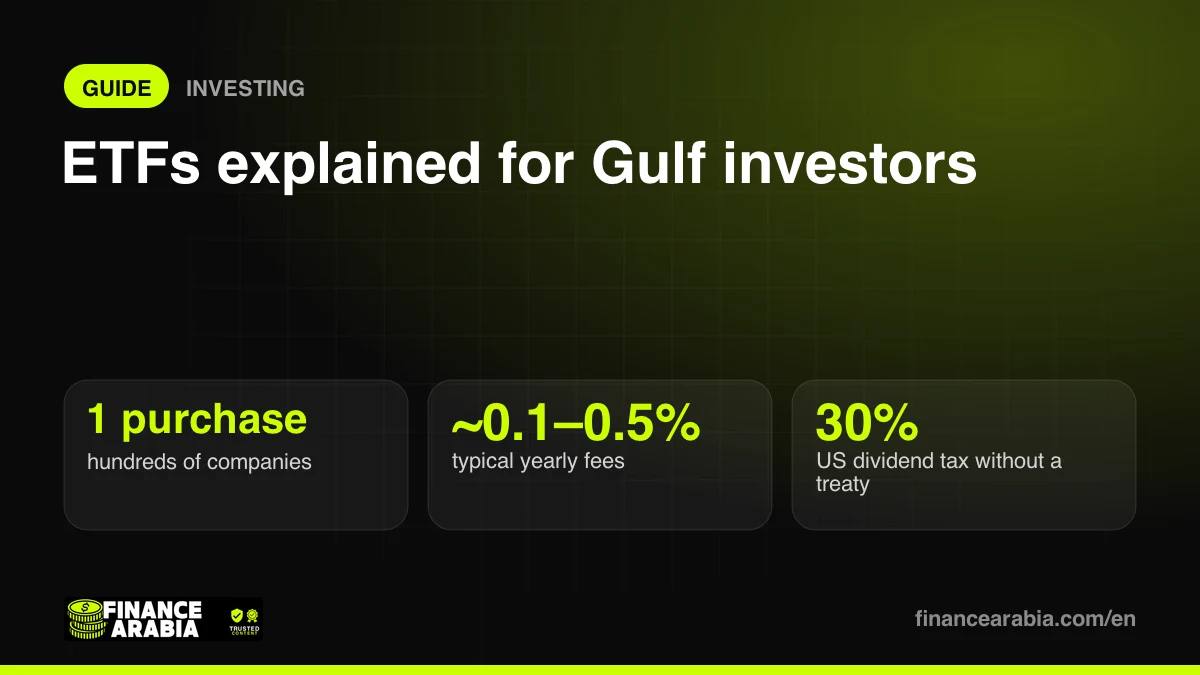
One purchase, hundreds of companies, tiny fees. How ETFs work, which ones Gulf investors look at, and the tax details most global guides miss.
By the Finance Arabia editorial team3 min read
Exchange-traded funds (ETFs) are one of the simplest ways to invest: one purchase gives you a slice of hundreds or thousands of companies, usually at a very low cost. For investors in the Gulf they're especially useful — but there are a few things you need to know that most global guides don't mention, from withholding tax on US funds to Sharia-compliant options. This guide covers the lot.
What is an ETF?
An ETF is a fund that trades on a stock exchange like a single share. When you buy one unit, you own a small piece of everything the fund holds — for example, all 500 companies in the S&P 500. Most ETFs are passive: they simply track an index, which keeps costs low.
Main types of ETF
| Type | What it holds | Risk |
|---|---|---|
| Broad market | A whole market, e.g. S&P 500 or MSCI World | Medium |
| Sector | One industry, such as technology or healthcare | Medium to high |
| Country / emerging markets | A single country or a group of developing markets | Medium to high |
| Bond | Government or corporate bonds | Low to medium |
| Commodity | Gold, oil and other commodities | Varies; oil is volatile |
| Dividend | Companies that pay regular dividends | Medium |
| Sharia-compliant | Stocks screened for Islamic principles | Medium |
Well-known ETFs Gulf investors look at
| ETF | Tracks | Approx. annual fee | Note |
|---|---|---|---|
| SPDR S&P 500 (SPY) | S&P 500 | ~0.09% | The oldest and largest ETF; US-domiciled |
| iShares Core MSCI World (IWDA) | Developed markets worldwide | ~0.20% | Irish-domiciled (UCITS), listed in London and Amsterdam |
| Wahed FTSE USA Shariah (HLAL) | Sharia-screened US stocks | ~0.50% | Sharia-compliant |
| SP Funds S&P 500 Sharia (SPUS) | S&P 500 minus non-compliant companies | Under 0.5% | Sharia-compliant |
| iShares MSCI Saudi Arabia (KSA) | Large Saudi companies | ~0.7% | Single-country exposure |
| iShares MSCI UAE (UAE) | Large UAE companies | ~0.6% | Single-country exposure |
Fees are approximate and can change — always check the fund's fact sheet. This isn't a recommendation to buy any particular fund.
Two things Gulf investors should know
1. Withholding tax on US funds
Dividends paid by US-domiciled ETFs (such as SPY) to non-US investors are subject to US withholding tax — 30% for residents of countries without a US tax treaty, which includes the UAE and Saudi Arabia. Irish-domiciled UCITS ETFs that hold US stocks generally suffer a lower 15% withholding inside the fund, which is why many international investors prefer them for long-term holdings.
2. US estate tax
Non-US investors can face US estate tax on US-situs assets — including shares of US-domiciled ETFs — above a relatively low threshold ($60,000). Non-US-domiciled funds such as Irish UCITS ETFs are generally not US-situs assets. If you hold significant amounts, take professional advice.
How to start, step by step
- Open a brokerage account with a regulated broker that gives access to global markets. (See our reviews for options.)
- Set your goal and time frame. Money you'll need within five years usually shouldn't be in stocks.
- Pick one or two broad, low-cost funds before anything specialised.
- Invest regularly — monthly automatic purchases smooth out market ups and downs.
- Review once or twice a year and rebalance if needed. Don't react to daily news.
See what regular investing can grow into with our compound interest calculator or plan income with the dividend calculator.
Pros and cons
| Pros | Cons |
|---|---|
| Instant diversification | You'll match the market, never beat it |
| Very low fees | Brokerage and FX costs on each purchase |
| Easy to buy and sell | Niche funds can be risky or illiquid |
| Transparent holdings | Tax treatment depends on where the fund is domiciled |
The bottom line
ETFs are the easiest way to own a diversified, low-cost portfolio. Start broad, keep fees low, invest regularly, and pay attention to where a fund is domiciled — for Gulf residents it can make a real difference to your returns.
General information only, not investment or tax advice. Investments can fall as well as rise.
Prices, fees and features change often. We check our facts at the time of writing, but always confirm the latest details with the provider. This article is for information only and is not financial advice.