Pay Off Debt or Invest? How to Decide What to Do With Spare Money
Paying off a loan is a guaranteed return; investing is an expected one. A simple way to decide — with worked examples and a balanced plan.
By the Finance Arabia editorial team3 min read
You've got some spare money — a bonus, a pay rise or savings you've built up. Should it go towards your loans, or into investments? It's one of the most common money questions, and the answer depends on a simple comparison plus a few things that don't show up in a spreadsheet. Here's how to decide.
Not all debt is equal
| Type of debt | Typical cost | Priority |
|---|---|---|
| Credit card balances | Often 30%+ a year | Pay off first |
| Personal loans (flat rate) | A flat rate that's roughly double as an APR | High |
| Car loans | Varies; often flat-rate | Medium to high |
| Mortgages | Usually the lowest rate you'll pay | Low — usually fine to keep |
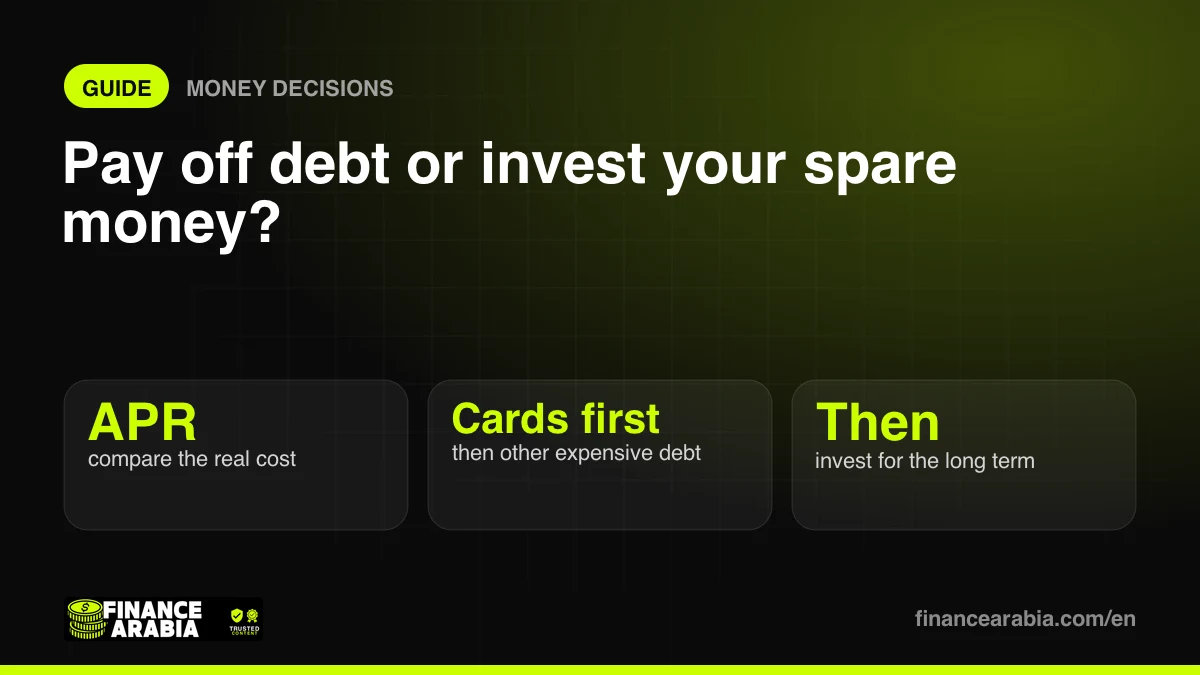
Before comparing, convert every loan to its real annual cost (APR). Many Gulf personal and car loans are quoted as flat rates, which hide the true cost. Our loan calculator converts a flat rate into its APR.
The simple rule: compare cost with return
Paying off a loan gives you a guaranteed return equal to its interest rate. Investing gives you an expected return that can be higher, lower or negative in any given year.
- If the loan's APR is higher than the return you can realistically expect → pay off the loan.
- If the loan is cheap and you have a long time horizon → investing may come out ahead, provided you can live with market ups and downs.
Example
You have AED 50,000 to spare. Your personal loan costs 12% a year (APR). A diversified stock portfolio might average 7–9% a year over the long run, with no guarantee.
| Option | Effect after one year | Certainty |
|---|---|---|
| Pay off the loan | You save about AED 6,000 in interest | Guaranteed |
| Invest the money | Perhaps AED 3,500–4,500 — or a loss in a bad year | Uncertain |
Here, repaying the loan clearly wins. But if the debt were a mortgage at a much lower rate and you were investing for 15+ years, investing could make more sense.
What the numbers don't show
- Peace of mind. Many people sleep better with no debt, and that's worth something.
- Job security. Expats on employment visas face more risk if they lose their job while carrying debt. Lower monthly obligations give you more room to manoeuvre.
- Borrowing capacity. Clearing loans lowers your debt burden ratio and can improve your credit score — useful if you plan to buy a home. See where you stand with the DBR calculator.
- Early settlement fees. In the UAE these are capped at 1% of the outstanding balance or AED 10,000, whichever is lower — check yours before repaying early.
- Market timing risk. Investments can fall just after you buy. Debt repayment can't.
A balanced plan
- Build a small emergency fund first — at least one month of essentials — so the next surprise doesn't go on a credit card.
- Clear high-cost debt: credit cards and anything with an APR above what you'd reasonably expect from investing.
- Complete your emergency fund (3–6 months of expenses).
- Invest the rest for the long term, while keeping up regular payments on low-cost debt such as a mortgage.
Putting it together
Say you have AED 100,000, a personal loan at 14% APR with AED 50,000 left, and a mortgage at a low rate. A sensible split: repay the personal loan in full, keep AED 20,000 as an emergency fund, invest AED 30,000 in a low-cost diversified fund, and carry on with the mortgage as normal.
FAQs
Should I pay off my mortgage early?
Usually it's the last debt to prioritise because it's the cheapest. Check early-settlement terms, and make sure you're investing enough for retirement first.
What about Islamic finance?
The same logic applies — compare the profit rate on your finance with what you expect to earn from Sharia-compliant investments.
The bottom line
Expensive debt first, safety net second, long-term investing third. And always compare on the real annual cost of your debt, not the advertised rate.
General information only, not financial advice. For large or complex decisions, speak to a licensed adviser.
Prices, fees and features change often. We check our facts at the time of writing, but always confirm the latest details with the provider. This article is for information only and is not financial advice.