UAE Gratuity Explained (2026): How End-of-Service Is Calculated, With Examples
21 days of basic pay per year, then 30 — but the details decide what you actually get. Worked examples, the rules on resignation and unpaid leave, and the new savings scheme.
By the Finance Arabia editorial team5 min read
Your end-of-service gratuity is often the single biggest payment you'll receive from an employer in the UAE — and one of the most misunderstood. People assume it's based on their full salary, that resigning cuts it in half, or that it only kicks in after a few years. Under the current labour law, none of that is true. This guide explains exactly how gratuity works in 2026, with worked examples you can check against our gratuity calculator.
The rules in one table
Gratuity for private-sector employees is governed by Federal Decree-Law No. 33 of 2021 (the UAE Labour Law), mainly Article 51. The essentials:
| Rule | What it means |
|---|---|
| Minimum service | At least 1 year of continuous service |
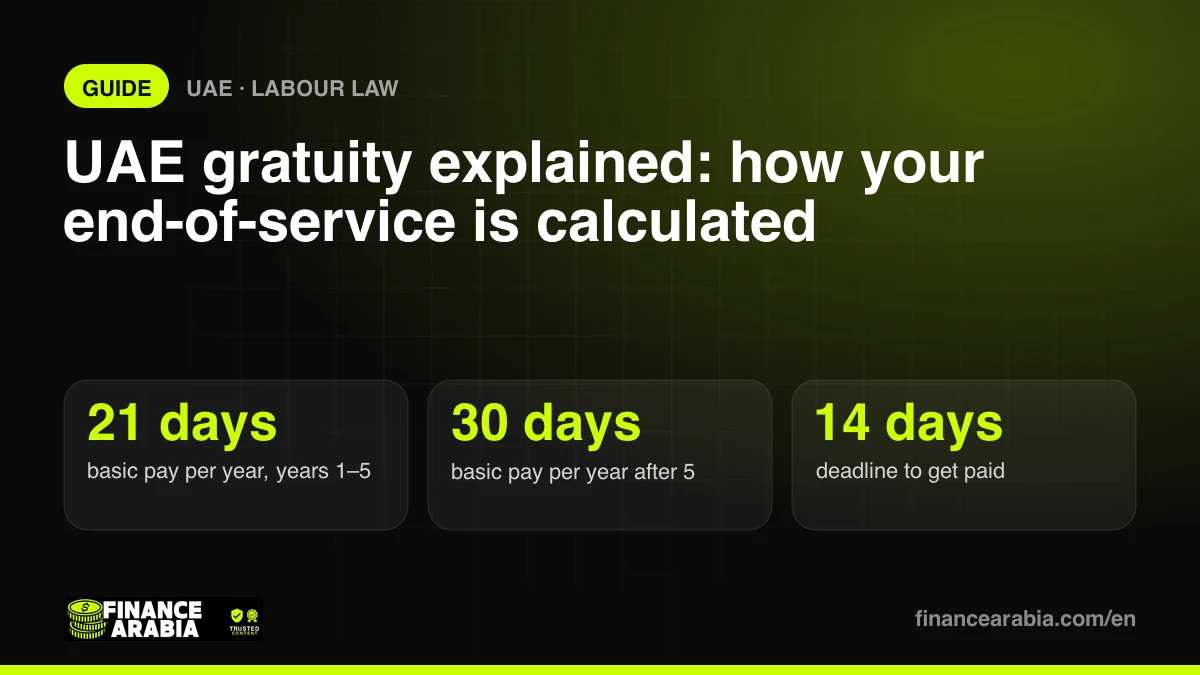
| First 5 years | 21 days of basic salary for each year |
| After 5 years | 30 days of basic salary for each additional year |
| Salary used | Your last basic salary — housing, transport and other allowances are excluded |
| Part years | Paid pro rata for the fraction of a year you worked |
| Unpaid absence | Days of unpaid absence don't count towards your service |
| Maximum | Total gratuity can't exceed two years' wages |
| Resignation | No reduction — you get the full amount after one year |
| Payment deadline | Within 14 days of the end of employment, with your other final dues |
How the daily wage is worked out
Everything starts with your daily basic wage: monthly basic salary ÷ 30. If your basic is AED 9,000, your daily wage is AED 300. "21 days of pay" is then 21 × 300 = AED 6,300 for each of your first five years.
That's why the split between basic salary and allowances in your contract matters so much. Two people on the same AED 20,000 package can end up with very different gratuities if one has a basic of AED 12,000 and the other AED 8,000.
Worked examples
Example 1: 3 years and 6 months, basic AED 6,000
- Daily wage: 6,000 ÷ 30 = AED 200
- Service: 3.5 years, all within the first five
- Gratuity: 3.5 × 21 × 200 = AED 14,700
Example 2: 7 years, basic AED 8,000
- Daily wage: 8,000 ÷ 30 = AED 266.67
- First 5 years: 5 × 21 × 266.67 = AED 28,000
- Next 2 years: 2 × 30 × 266.67 = AED 16,000
- Gratuity: AED 44,000 — about 5.5 months of basic salary
Example 3: hitting the cap
With a basic of AED 10,000 and 27 years of service, the formula gives AED 35,000 for the first five years plus AED 220,000 for the next 22 — AED 255,000. The cap is two years' wages (24 × 10,000 = AED 240,000), so you'd receive AED 240,000.
Want your own number? Enter your exact joining date and last working day in the gratuity calculator — it counts the days for you.
Resigning vs being terminated
Under the old law, resigning early could cut your gratuity to a third or two-thirds. That was scrapped when the 2021 law took effect. Today, whether you resign or your employer ends the contract, the formula is the same once you've completed a year. The main exception is dismissal for gross misconduct under Article 44 of the law, where an employer can terminate without notice — disputes over those cases go to the Ministry of Human Resources and Emiratisation (MoHRE).
Free zones, DIFC and the new savings scheme
- Most free zones follow the same federal gratuity rules.
- DIFC replaced gratuity with the DEWS workplace savings plan in 2020: your employer pays monthly contributions into an investment plan instead of a lump sum at the end.
- The voluntary savings scheme: since Cabinet Resolution No. 96 of 2023, private-sector and free-zone employers can opt into an alternative scheme. They pay 5.83% of your basic salary each month for your first five years and 8.33% after that into approved investment funds. You receive the contributions plus any returns within 14 days of leaving — and can keep the money invested.
If your employer has joined the scheme, your payslip or HR portal should show it. If not, the standard gratuity formula applies.
Five things to check before your last day
- Your basic salary on paper. Check your MoHRE contract, not just your offer letter.
- Your joining date. Service usually counts from the start date in your labour contract.
- Unpaid leave. Any unpaid absence will be deducted from your service days.
- What else is in your final settlement: unused annual leave, salary for days worked, notice pay and a return ticket if your contract includes one.
- Deductions. Employers can deduct amounts you genuinely owe them, such as an outstanding salary advance.
What if you don't get paid?
Your employer has 14 days. If the payment doesn't arrive, or the amount looks wrong, raise it with HR in writing first. If that fails, you can file a labour complaint with MoHRE through its website, app or call centre (800 60). Keep copies of your contract, payslips and any correspondence.
FAQs
Is gratuity paid on basic or gross salary in the UAE?
On your last basic salary only, unless your contract says otherwise.
Do I get gratuity if I resign before one year?
No. You need at least one year of continuous service.
Is gratuity taxed in the UAE?
No. The UAE doesn't levy personal income tax, so your gratuity is paid in full. If you move back to a country that taxes worldwide income, check the rules there.
Does gratuity apply to part-time workers?
Yes. Part-time employees are entitled to gratuity calculated in proportion to the hours they actually worked.
The bottom line
UAE gratuity is simpler — and fairer — than many people think: 21 days of basic pay per year for the first five years, 30 days after that, the same whether you resign or not, paid within 14 days. The one number to watch is your basic salary. Plug your details into the gratuity calculator to see what you're owed today.
Based on Federal Decree-Law No. 33 of 2021 and Cabinet Resolution No. 96 of 2023, as of October 2026. This guide is general information, not legal advice; special contract terms and individual cases may differ.
Prices, fees and features change often. We check our facts at the time of writing, but always confirm the latest details with the provider. This article is for information only and is not financial advice.