stc Bank Review 2026: Cards, Fees, Cashback and Is It Worth It?
Can stc Bank be your main bank in Saudi Arabia? We look at the cards, the real fees, the strengths and weaknesses, and how it compares with traditional banks.
By the Finance Arabia team5 min read
A few years ago stc pay was just a wallet people used to send money home or split a restaurant bill. That changed in January 2025, when the Saudi Central Bank (SAMA) cleared it to operate as stc Bank — the Kingdom's first fully digital bank to grow out of an e-wallet. The question many people in Saudi Arabia now ask is simple: can it be your main bank, or is it better as a side account for everyday spending?
This review covers what the bank actually offers, the real cost of each card, who gets the most out of it, and where it still falls short of the traditional banks.
Quick verdict
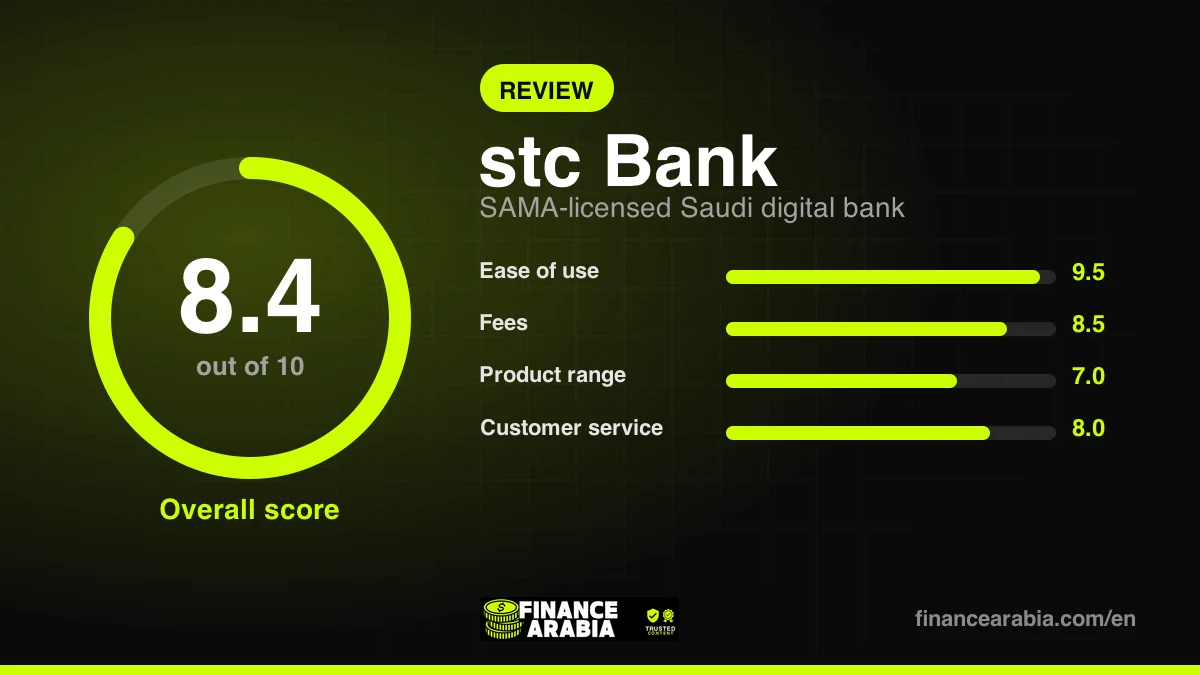
| Overall score | 8.4 / 10 |
|---|---|
| Best for | Everyday spending and international transfers |
| Biggest strength | Free card with 0.5% cashback |
| Biggest drawback | Financing products still limited |
| Ease of use | 9.5 / 10 |
| Fees | 8.5 / 10 |
| Product range | 7.0 / 10 |
| Customer service | 8.0 / 10 |
What is stc Bank?
stc Bank is a Saudi digital bank owned by the stc group. There are no branches — everything runs through the mobile app. Existing stc pay customers were moved across automatically, and the bank said it had around 1.5 million customers at its official launch. All products are Sharia-compliant and approved by the bank's Sharia board, and it is supervised by SAMA exactly like any other Saudi bank, so your deposits sit under the same rules.
The real difference from a traditional bank isn't the licence, it's the experience. You can open an account in minutes through Nafath, and everything from freezing a card to changing your spending limits happens inside the app.
Cards and fees in detail
There are four cards, each available instantly as a virtual card and as a physical card, and all of them work with Apple Pay and mada Pay. The main differences are the cashback rate and the fees:
| Card | Cashback | Annual fee | Monthly fee | Best for |
|---|---|---|---|---|
| mada | None | Free | Free | Everyday local spending |
| Classic | 0.5% | Free | Free | Most people |
| Platinum | 0.7% | SAR 200 | SAR 20 | Heavy monthly spenders |
| Signature | 1% | SAR 500 | SAR 50 | Frequent travellers with high spending |
Here's the part most people miss: the paid cards only make sense if you spend a lot. The gap between Classic (0.5%) and Signature (1%) is just half a percent, so you'd need to put more than SAR 100,000 a year on the card just to cover Signature's annual fee — before the monthly fee is even counted. For most people the free Classic card is the smarter choice.
What makes it worth trying
- An account in minutes: no branch visit and no paperwork, just Nafath.
- Instant virtual card: add it to Apple Pay before the physical card arrives.
- Full control in the app: freeze a card, set spending caps and switch online purchases on or off for each card.
- International transfers: the bank inherited stc pay's large remittance network, which many expats in Saudi Arabia already use to send money home.
- Cashback on a free card: 0.5% on Classic with no fees at all — something most free cards on the market don't offer.
Drawbacks to know about
- No branches: if you hit a complicated problem, customer service is your only route.
- Financing and investing are still early: the bank has announced plans for personal and business finance, but its range is still much thinner than the big banks'.
- The paid cards are expensive: combining an annual and a monthly fee makes Platinum and Signature poor value for average spenders.
- Everything depends on your phone: lose your phone or hit an app outage and you temporarily lose access to your account.
stc Bank vs a traditional bank app
| Feature | stc Bank | Traditional bank (app) |
|---|---|---|
| Opening an account | Minutes, on your phone | Usually in the app; some services need a branch visit |
| Branches | None | Large branch and ATM network |
| Free card with cashback | Yes (0.5%) | Rarely |
| Personal and home finance | Limited for now | Wide choice |
| International transfers | Quick and easy | Available, often more expensive |
Who is stc Bank for?
It suits young people, students and employees who want a fast account for daily spending with free cashback, expats who send money abroad regularly, and anyone who prefers to manage everything from their phone.
It isn't enough on its own if you need a large mortgage or personal loan right now, or rely on branch services. The practical setup for many people: keep your salary in a traditional bank and use stc Bank for everyday spending and transfers.
FAQs
Is stc Bank an official, licensed bank?
Yes. It received approval from the Saudi Central Bank in January 2025 to operate as a digital bank and is regulated in the same way as other Saudi banks.
Can expats open an stc Bank account?
Yes — residents with a valid Iqama can sign up through the app using Nafath, just as stc pay users could before.
Can I get my salary paid into stc Bank?
Your account has its own IBAN and receives transfers like any other bank. Whether your salary can go there depends on your employer's payroll policy.
Which stc Bank card is best?
For most users, Classic: it's completely free and pays 0.5% cashback. The paid cards only pay off with very high annual spending.
The verdict
stc Bank is a mature step from a successful wallet to a real bank. Its strengths are clear: speed, an excellent app, a free card with cashback and easy international transfers. Its main weakness is that financing and investment products are still taking shape. If you want a smart everyday account, it's one of the best options in Saudi Arabia right now — but for big-ticket borrowing, keep a traditional bank until stc Bank's lineup matures.
Information and fees are correct as of October 2026 and may change. Check the app or the bank's official website before you decide.
Prices, fees and features change often. We check our facts at the time of writing, but always confirm the latest details with the provider. This article is for information only and is not financial advice.